All professional historians in the field of Babi-Baha'i
studies in the Qajar period are convinced that the
Kitab-i Nuqtat al-Kaf (ed. E.G. Browne and Muhammad Qazvini, vol. 15 of the E.J.W. Gibb Memorial Series, Leiden, 1910 and digitally reprinted in 1997 at H-Bahai), contains early primary material for
the study of Babism. These historians include Abbas Amanat, Denis
MacEoin, Mangol Bayat, John Walbridge and myself,
and many others.
Progress in historical understanding with regard to
this volume has been impeded, however, by unfortunate
traditions of polemic that are profoundly unhistorical
in their basic premises. The polemical stories about
the Kitab-i Nuqtat al-Kaf, are based either on the idea
that it is a late and "corrupted" semi-forgery, or on the idea
that there was one "true" and "genuine" "original"
Babi chronicle which was then dishonestly "tampered
with" or "interpolated."
The following passage by Douglas Martin neatly summarizes one school of polemics on this issue:
". . . the principal source used [by William Miller] for this period (apart from Mr. Azal) is an extraordinary
manuscript produced by unknown writers some time between 1852 and 1863, under the title
NUQTATU'L KAF. In his study on the work of Professor Browne, Mr. Balyuzi has
demonstrated the unreliability of this strange melange of historical narrative, superstition, nihilistic
thought, and naive partisan propaganda. He also rescues the reputation of Mirza Jani, the merchant
and Babi martyr whose name and memoirs were misused by the compilers of the work. For a
modern writer to discuss the subject, therefore, would again have required coming to grips with the
argument contained in the Balyuzi critique. The challenge is particularly acute for Rev. Miller, as the
thesis of the section of his book which deals with the Babi period rests squarely on the authenticity of
the KAF manuscript. Rev. Miller seems aware of the seriousness of the problem, but the one lengthy
footnote which he devotes to the Balyuzi study is both superficial and essentially off the topic.(23)
Ignoring the obstacle, he simply attributes the manuscript to Mirza Jani and asserts that it is "the
earliest and best history" of the Babi movement." (Douglas Martin, "The Missionary as Historian: William Miller and the Baha'i Faith," Bahá'í Studies vol. 4 (Dec. 1978)
The problem, of course, is that H.M. Balyuzi did not "demonstrate" that the Nuqtatu'l-Kaf was
"unreliable." (H. M. Balyuzi, Edward Granville Browne and the Baha'i Faith, Oxford: George Ronald, 1970). He simply asserted it. It was the editors (Browne and Qazvini) who asserted that it was by Haji Mirza Kashani (a claim not made in the text itself), though it is certainly the case that some portion of this work derives from his early chronicle. The book is no more 'superstitious' than Baha'i chronicles such as Nabil's Narrative, The Dawnbreakers. It is no more 'propaganda' than any other chronicle written by Babis
and Baha'is in the nineteenth century. Unfortunately, Balyuzi began with an assumption that the
early Babis could not possibly have believed certain things, then used that anachronistic assumption
in an attempt to discredit the Nuqtatu'l-Kaf. Martin, an influential Baha'i leader who has not the slightest standing to pronounce on nineteenth-century Persian primary sources, simply excoriates the book without any analysis whatsoever (knowing no Persian, he could do little else). He at one point admits that it is dated 1854 or 1863 (which is it?), an admission that suggests the author was an eyewitness to many events of the previous decade or two and thus a primary source. He does not explain how it is that, if Nuqtatu'l-Kaf is so useless and unreliable, it overlaps so strongly with many other later Babi chronicles of the nineteenth century, including the Baha'i work, Mirza Husayn Hamadani's New History or Tarikh-i Jadid (1882).
Martin goes on to remark of E.G. Browne's own work, "These are extremely valuable documents and have been heavily used
by various scholars, both Baha'i and non-Baha'i, in succeeding decades. As a professional scholar,
however, Professor Browne himself would have been the first to recognize that his work would
inevitably be subject to revision, as later generations freed themselves from the particular political
and cultural context in which he was working, and as further historical evidence surfaced. Indeed, the
process of revision has been recognized as an integral part of the writing of history ever since
historiography moved out of the nineteenth century's naive belief that it could write "scientific history,"
"history as it really happened." But if this is true of E.G. Browne, why is it also not true of nineteenth
century Babi chronicles such as Nuqtat al-Kaf? Would not its author have had his own "political and cultural context?" And would not subsequent chroniclers have "freed themselves" from that earlier framework, even while existing within their own "political and cultural context?" Martin's willingness to see Browne's work in this relativizing but generally favorable light contrasts strongly to the polemical and unanalytic approach he takes to Nuqtat al-Kaf.
An almost mirror image of Martin's approach can be found in the work of the Iranian intellectual,
Muhit-i Tabataba'i, who argued that the Nuqtat al-Kaf is the suppressed "original" for all
subsequent Babi-Baha'i histories, which are thus corruptions and dishonest departures from its pristine authenticity. That this approach is as objectionable as the Balyuzi/Martin tack should be immediately obvious. (Muhit Tabataba'i, "Kitabi bi nam ba nami tazih," Gawhar, 11-12 (1353/1974):952-961.
I think that the approaches
taken by scholars to the formation of the New Testament Gospels
are far more likely to be productive here.
Higher Criticism recognizes that when a new religion arises, a body of oral narratives
is built up, which someone at length commits to paper,
and which is then edited or redacted by later authors,
who collate several such accounts, add material, rewrite,
attempt to correct contradictions, and often recast
things in light of later developments in religious
doctrine. Luke is not generally thought to have "tampered"
with the original "Q" document most New Testament scholars
believe lies behind the Synoptic Gospels. In the case
of Babi history, our "Q" has a known author, Haji Mirza
Jani Kashani, and this version may even exist, according
to some Iranian Baha’i historians. A new approach to these problems
has been made possible by Denis MacEoin, among the foremost academic
scholars of the Babi movement, in his The Sources for Early Babi Doctrine
and History, Leiden: E.J. Brill, 1992), 134-160. However, his discussion
leaves many puzzles unresolved and I would like to propose a set of heuristic
solutions to these problems. That is, my proposals must necessarily at the
current time be 'thought experiments' rather than conclusive. My key suggestion
is that the Nuqtat al-Kaf is not one book, but a manuscript tradition with
many redactions over time. In manuscript cultures, books are produced by copying.
There are two main sorts of copyists, those who simply transmit the manuscript to the
best of their ability, and those historians in their own right who edit or redact it as they copy,
adding information to which they have access, or dropping passages that seem to them
mistaken or no longer useful. Thus, the early chronicle of the life of the Prophet Muhammd, by Ibn Ishaq, was redacted by Ibn Hisham, and it is only in Ibn Hisham's edition that the work of his predecessor now survives. The great British scholar of Islam, Marsden Jones, once told me that the was convinced that at least one MS of Ibn Ishaq still survived, but that it could not be published in toto because it preserved the scandalous poetry produced against the Prophet by his Meccan antagonists. I believe that Nuqtat al-Kaf was similarly transmitted by a
handful of historian-copyists, each producing a new manuscript that
incorporated significant portions of the previous one.
Haji Mirza Jani Kashani wrote a very early chronicle
of the Babi movement, perhaps around 1850 or 1851.
Let us call it “Codex 1851.” This work was only one
of many such chronicles, though it may have differed
from some others in treating several episodes rather
than only one. This Codex 1851 may or may not survive in some
collection in Iran. However, no manuscript of it has yet been
positively identified, and the political situation in Iran may have to
change before further searches can be undertaken.
Yet another early Babi chronicle
was written around 1854 (1270 A.H.) by an eyewitness
participant in the movement. It was in part based on the earlier
work of Haji Mirza Jani, but it also reflected the views
and beliefs of some segment of Babis at that slightly later time.
It is not important who this author was, only important
that he was a Babi of that time and therefore a primary
source. I will arbitrarily call it "Codex 1854." From
later developments we may conclude that while it incorporated
a good deal of material from the chronicle of Haji Mirza Jani
Kashani, it did not use other passages from that work,
and also had original writing. For instance, MacEoin points out that
the account of the Bab's stay with Haji Mirza Jani in Kashan,
which he had written about at length, is absent from the later manuscript
tradition. (Manuscript authors
tended to borrow from one another prodigiously and
tinker with the text; plagiarism was an unknown notion,
as was fidelity to some "original"). I will call the author of Codex 1854
"Anonymous" since we cannot be sure who it was.
(It was certainly not Haji Mirza Jani Kashani, since it describes events occurring after
the latter's death; but it may have
been his brother, Haji Mirza Isma`il Dhabih, according to
Denis MacEoin, The Sources for Early Babi Doctrine
and History, Leiden: E.J. Brill, 1992), 134-160. (This makes some
sense since we know that Dhabih was in fact a historian, and later
wrote a verse chronicle of Baha'u'llah's life.)
To be sure, the author's identity cannot be known for
certain. For non-historians, and especially for those involved
in polemics and apologetics of a religious nature,
the fact that the book is anonymous or that it comes
to us in a later, edited, form, may seem to weaken
its reliability. But professional historians encounter
this sort of situation all the time, and one does not
ignore an important primary source just because one
does not know the name of the author!
All three editions of the "old history" of the Babis examined by Denis MacEoin--the Haifa MS., the Tehran MS., and the printed Nuqtat al-Kaf, contain a reference to the year being 1270 A.H. or 1853-54, and so all three are descendants of Codex 1854, which also has not recently been seen in its original form, though the later redactions that produced the Tehran and Haifa MSS may not have changed it very much. It seems likely that Codex 1854 began with the theological treatise entitled the Nuqtat al-Kaf. I say this because all three of its descendants include part of it. The Paris MS published by Browne, of course, included the entire piece as a prolegomenon to the historical narrative. But the Haifa and Tehran MSS both begin, not with straight history, but with the last part of the theological treatise (and begin at different points in it). The theological treatise dated probably from the late 1840s. It may have seemed less and less relevant to Babi theology as time went on and so was dropped by some copyists in favor of the historical narrative. Since the theological treatise properly speaking gives the book its title, I think we may certainly begin speaking of Kitab-i Nuqtat al-Kaf or the Point of Kashan with Codex 1854. I do not know if the chronicle of Haji Mirza Jani, the Codex 1851, began with this theological treatise.
Although many authors have put much emphasis on the unparalleled value of
Codex 1851 and Codex 1854, they are not necessarily
unique. A fair number of chronicles by eyewitnesses of various episodes
of the Babi movement survive, as does a large cache
of letters and documents from the 1840s, in the hands
of the Afnan family and at the Baha’i World Center
in Haifa. Some of the early manuscript sources dating to the 1840s have been quoted at length by Asadu'llah Fadil Mazandarani in his Tarikh-i Zuhur al-Haqq, volumes 2 and 3 (of which only volume 3 has been published, and recently put up on the Web at H-Bahai). Also of interest in this connection is the
undated, anonymous “Tarikh-i Babiyyih” (Babi Chronicle),
which exists in manuscript at Princeton, and which
was used by Mangol Bayat in her Mysticism and Dissent (Syracuse University Press, 1982).
Until all the other chronicles and materials are studied, and Jani Kashani's
own manuscript is discovered or reconstructed,
we cannot even be certain that Codex 1851
is uniquely early; and the letters possessed
by the Afnan clan in particular are even earlier and more primary
in nature than this narrative. The point is that a manuscript tradition was beginning to grow that saw the Babi period as a unity, but that it was only one tradition among several.
The "Codex 1854" was then
further redacted in 1863, either by the original author,
or by a later hand. I say this because on p. 266 of the printed
edition, the author says that the Babis "have not been wiped out,
but grow more every day; nor is it that this faith is only made manifest in Iran, for it has spread to every land, including Anatolia (Rum), India, and Turkistan . . . I have heard that there is a large group . . . in Istanbul" (MacEoin's translation). But there was no "large group" of Babis in Istanbul until Baha'u'llah was exiled there in 1863. All three of the MSS of the "old history" seen by MacEoin also appear to contain this passage, which seems to me late. As well, two of the three contain a reference to Azal as the leader of the Babis, not something in my view that a Babi chronicler would necessarily have maintained in either 1851 or 1854, but something the vast majority of Babis believed in 1863. Codex 1863 is the manuscript represented by the Tehran and Haifa MSS studied by Denis MacEoin.
Yet a third redaction was made sometime before the 1865-1866 break between Baha'u'llah and Azal, presumably around 1864. This is the Paris MS (so called because it came into the possession of Arthur Comte de Gobineau and was eventually auctioned there). This edition retains the passage speaking well of Baha'u'llah, which a post-1866 Azali would not. At this time, extra material (pp. 106-125 and 185-200) was added by the anonymous historian. The first of these long sections treated the early career of the Bab, and the second detailed that of Mirza Yahya Subh-i Azal, whom perhaps a majority of Babis in the mid-1860s saw as the Bab's successor..
This material does not appear in either the Haifa or the Tehran MS of the "Old History" seen by MacEoin. Of course, it could be argued that the Haifa and Tehran MSS were redacted so as to excise material previously contained in this chronicle tradition about Azal. But I simply do not believe Azal had been important or famous enough to have been discussed at such length in works written in 1851 or 1854, nor does he appear prominently in other early Babi chronicles. Moreover, the Haifa manuscript does contain a favorable reference to Azal, and passages about him are illuminated; there is therefore no reason for its redactor to have deleted the long sections about him. Also, the Haifa/Tehran manuscript tradition lacks the excursus on the life of the Bab to 1847 or so, and there is no reason for Babi authors of any persuasion to have dropped such material. The most likely explanation is that the Haifa MS is based on a Codex 1863, before the Azal material was added in the circa 1864 Paris MS., and that the old Haji Mirza Jani chronicle tradition had concentrated on the Bab's last years, leading to a gap that the Paris MS. filled. [Note added 10-4-00: Browne in his introduction to the Nuqtat al-Kaf says "one copy" of the work was "brought out of the country about the year 1863," but it is not clear why he gives this date for it coming into Gobineau's possession; Browne, 1910, p. xix.]
MacEoin is not the only one to have found such alternative versions of the "Old History."
Ahang Rabbani has written, that “Hisam Nuqaba'i in Manabi`
Tarikh-i Amr-i Baha'i (Sources of Baha'i History),
133 BE (1975), p. 31, notes: ‘Recently, the diffuser
of divine fragrance, Jinab-i Badi`u'llah Farid, has
found the original of the old and authentic Nuqtatu'l-Kaf
and after having compared it with the published version
by Browne, has determined that its contents, with some
slight differences, are one and the same. However,
when the discussion is about [Mirza Yahya] Azal, then
a considerable amount of materials about his station
and personality [were] added to the text and do not appear
in the original version. This is especially evident
as these sections differ in both style and composition
from the rest of the book. Its is our hope that several
photocopies of this [authentic] manuscript be prepared
so that it would remain safe from the accidents of
time.’” (Rabbani H-Bahai posting of September, 1997). Whether
the book found by B. Farid was the chronicle of Haji Mirza Jani, or it was
the Codex 1854 or Codex 1863, could only be decided by examining the MS., which one hopes
survived the Islamic Revolution of 1978-79 in Iran, in the course of which
Farid himself was executed for his faith. Rabbani maintains that `Abdu'l-Baha ordered that the
chronicle of Haji Mirza Jani be published.
The Paris MS published by Browne, i.e., the "Paris"
manuscript, bears traces of all four dates, 1850/51,
1854, 1863, and 1864. It clearly contains material from Haji
Mirza Jani's 1851 chronicle (he died in the persecutions
of 1852). But it twice mentions the date as being 1270 (began
Oct. 1853), and contains accounts of events occurring
after 1851. As Denis MacEoin has shown, it contains
early accounts that do not come from Haji Mirza
Jani, including some events relating to the latter!
As already noted, elsewhere the text
mentions that Babis have gathered in Istanbul, which
seems to point to 1863 and therefore to a further redaction. The new
material on Azal, I argue, was added circa 1864. I do not think this
added material on Azal is false, but it does give a
false impression of how prominent he was in 1848 (in
fact, he was almost certainly barely noticed by the
Babis at that point, a 19 year old adolescent overshadowed
by his slightly more prominent brother, but even more
by all the eminent Letters of the Living). The subsequent history of what I am calling
the circa 1864 Paris MS is full of ironies. Since at least three manuscripts are attested lacking the extended
passages about Azal, it appears not to have been an important link in the chain of manuscript
transmission. It may well be that Gobineau acquired it not too long after its composition, and that, as a unique MS, it therefore went out of circulation in Iran. Although the author was attempting to update the "Old History" by including the material on Azal, then the foremost Babi leader and widely recognized as the Bab's vicar in Iran, the ground was about to shift toward Baha'u'llah. With the rise of the Baha'i faith in the late 1860s Azal was increasingly marginalized. The Codex 1863, which paid much less attention to Azal, would therefore have been more popular with Baha'i copyists from the late 1860s. Only by being published by Browne and Qazvini in 1910 did the Paris manuscript suddenly become the most well known redaction of early Babi history! And by that time not only did Baha'i authors not welcome pp. 185-200, but they had become hostile even to the early material preserved from Jani Kashani and his successors. Babism had been militant and its theology was shot through with Shi`ite esotericism. The Baha'i faith had pacifist leanings and had striven for a more rationalized theology. That the Baha'is' heroic forebears could have been so bellicose and could have believed so many things now difficult to believe struck them as impossible. And so began the long tradition of calumniating the Paris MS of Nuqtat al-Kaf as a forgery, from Gulpaygani through Balyuzi and Martin.
Anyone who knows how manuscript transmission works will
not be at all surprised by the existence of further 1863 and
1864 "editions" of Codex 1854. This does not mean that
the earlier chronicle was corrupted. It was redacted
or edited for the needs of a particular author, time,
or place. The Gospels went through similar processes. Only with the rise of
print, a medium that had barely made an impact on 19th century Iran, did authors
and texts begin to become fixed in some ways. In the days of manuscript transmission,
every copyist who was also a historian felt free to modify the text and make it his
own.
The Paris MS retains the full version of the early Babi theological
treatise (composed in the late 1840s) called the Nuqtat al-Kaf or the Point
of Kashan. I argued above that in this it probably carried over from Codex 1854. It is absurd to
believe that either Browne or Qazvini tampered with the
manuscript text from which they worked. The adulatory passages about Azal in the Paris
MS were, of course, among the more objectionable parts of Nuqtat al-Kaf to the later Baha'i
tradition, insofar as they painted him as the pious, legitimate successor of the Bab, whereas
Baha'is came to see him as a duplicitous usurper who ultimately refused to recognize "He whom
God shall make manifest," the Babi messiah, in the person of Baha'u'llah. But the depiction of Azal in
Nuqtat al-Kaf is simply the image prevalent among a majority of Babis around 1864. Even the Afnan clan in Shiraz, who had been converted by Baha'u'llah himself, initially revered Azal and objected when partisans of Baha'u'llah began burning his books. And Kazim Samandar also admits in his chronicle that most Babis before 1865 revered Azal. The material about Azal in Nuqtat al-Kaf is not early and does not derive from Haji Mirza Jani. But that does not make it historically useless. And Jani Kashani himself, if he was a typical Babi, died believing the head of the faith was `Azim Turshizi in Tehran or any of a number of other Babi "manifestations" of the early 1850s. That is, his beliefs would not have been greatly more acceptable to later Baha'is than were those of the author of Nuqtat al-Kaf.
As noted, Muhit Tabataba'i maintained that all subsequent Baha'i
reworkings of Babi history, including the Tarikh-i
Jadid or The New History of Husayn Hamadani
and Muhammad “Nabil-i A`zam” Zarandi in his Matali`
al-Anwar or The Dawnbreakers, depended primarily
on Nuqtat al-Kaf (i.e. the Paris MS or "Codex 1864") while carefully excising
the elements characteristic of early Babism, such as belligerency and the leading position
of Azal. But while Baha'i authors did frequently play down Babi militancy, this
allegation is too simplistic. The Babi movement involved thousands
of persons, and they produced a wealth of memoirs and
short chronicles, some of which have become known to us through the work of
Fadil Mazandarani, Abbas Amanat, Mangol Bayat, Denis MacEoin, and Ahang Rabbani. Hamadani
in his New History says he used Haji Mirza Jani's early
Chronicle, my “Codex 1851”; he may also have had access
to the later elaborations of this manuscript tradition.
And he used other sources, as well. Nabil certainly employed a
whole range of sources, both manuscript and oral. If
there were half a dozen or a dozen or even dozens of
chronicles by eyewitnesses, then Nuqtat al-Kaf
was just one version (or set of versions) of these events among many. This means
that the book is less important than Browne thought,
but it also means that there is no reason it cannot
be an authentic primary source in its own right, which
needs to be collated with other primary sources.
Of course, the chief virtue of the Kitab-i Nuqtat al-Kaf is that it has
been published and is available to scholars. However, since MacEoin has confirmed that this book is largely identical to the Haifa and Tehran MSS of the "Old History" except for the absence in them of pp. 106-125 and 185-200, we may conclude that Codex 1863 is the more important manuscript tradition, which is now easy enough to reconstruct.
Resources are becoming available for the academic study of this issue. The
attempt at refutation of Browne's edition of Nuqtat al-Kaf by Mirza Abu'l-Fadl
Gulpaygani (completed by his nephew), the Kashf al-Ghita, was very rare but has now been republished on the World Wide Web by H-Bahai. Although Gulpaygani is convincing in showing that Nuqtat al-Kaf is not precisely identical with the early Codex 1851 of Haji Mirza Jani Kashani, he does not succeed in discrediting the book as a primary source (or a redaction of primary sources) in its own right, and he, like other polemicists on the issue, confuses the natural process of redaction and rewriting of manuscript chronicles with deliberate forgery. In addition, the original Persian MS of the Tarikh-i Jadid
(New History) was discovered in the 1980s by
Susan Maneck in the Kama Oriental Library, Bombay,
the repository of the papers of Lima Hataria Manikji
Sahib, who had commissioned it, and is available to academics in photocopied form.
Ahang Rabbani has demonstrated that the British Museum manuscript identified
as the Tarikh-i Jadid is actually yet a further
redaction of this Babi chronicle tradition, carried
out by Muhammad Nabil Qa’ini, the great Khurasani Baha’i
mujtahid in the 1890s, and properly entitled the Tarikh-i
Badi`-i Bayani (The Wondrous Babi Chronicle).
All this points to the need for a critical edition of
Nuqtat al-Kaf, and for the need to collate the
various Babi chronicles. Luckily, making a critical
edition has become easier and more interesting on the
Web, as has collation, with many hyperlink possibilities. It seems
possible that with the Iranian Baha'i diaspora some copies of the
earlier Codex 1851 and Codex 1854 may surface. Since only a century ago, Husayn Hamadani and Mirza Abu'l-Fadl both saw the “Codex 1851” of Haji Mirza Jani, however, it would be
very strange if the former did not survive somewhere.
But it should be pointed out that since Haji Mirza
Jani was a Babi and writing in 1850-51, he almost certainly
entertained views, with regard to militancy, the station
of Mulla Husayn and Quddus, and theology, which differ
from the later, quietist, Baha’i tradition. This is the essential point
that Gulaygani, Balyuzi, Martin and other polemicists never accepted, making them
guilty of anachronism.
The book that has become known as Nuqtatu'l-Kaf
undeniably retains great importance for the study of the Babi
movement, and contains large amounts of early primary source
material. Even what I argue are later passages about Azal are an important
historical source. What is wanted is a critical edition that would put the
Paris MS in context, and for that more exemplars are required. Miller
maintained that a manuscript of this work was given
to Princeton, though it is not listed in the current
catalogues. MacEoin lists a number of exemplars at
the Baha’i World Center in Haifa. Certainly, enough
exists to make a critical edition if all parties would
cooperate.
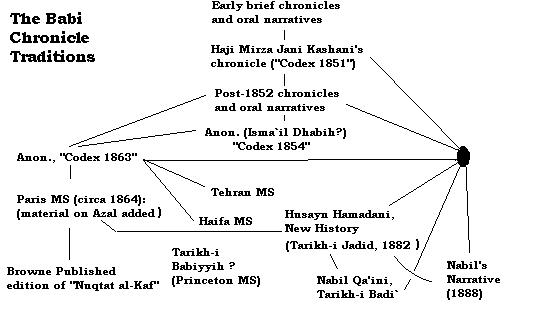
In closing, I would like to suggest a diagram for the
family of Babi manuscript traditions related
directly to Haji Mirza Jani’s “Codex 1851.”
Chart I

Return to Research Notes in Shaykhi, Babi, and Baha'i Studies
Return to H-Bahai Digital Publications
Return to H-Bahai Home Page
Links to pages with similar resources

|
Generously Supported by:
|
|
![[MICHIGAN STATE UNIVERSITY]](/~bahai/graphics/footer~2.gif)
|
&
|
![[The National Endowment for the Humanities]](/~bahai/graphics/footer~3.gif)
|
